

Office Movers in Dubai —
Corporate Relocation with IT Equipment Handling,
After-Hours Scheduling, and Minimal Business Downtime
Office relocation in Dubai requires more planning than most moves because the stakes are different. Every hour of downtime is a cost. Every unconnected workstation delays an employee. Every misplaced document creates a problem. And every office building in Dubai — free zone, commercial tower, or mixed-use development — has its own permit process, freight lift rules, and loading restrictions that have to be resolved before the crew arrives.
E MoverAE handles office relocations across Dubai's business districts — Business Bay, JLT, DIFC, Dubai Internet City, Sheikh Zayed Road, Al Quoz, DAFZA, and beyond. Moves are planned around your operational schedule, not ours. Most corporate clients choose a Friday evening start and Saturday completion so staff walks into a working office on Sunday morning. We build the whole move plan around that deadline.
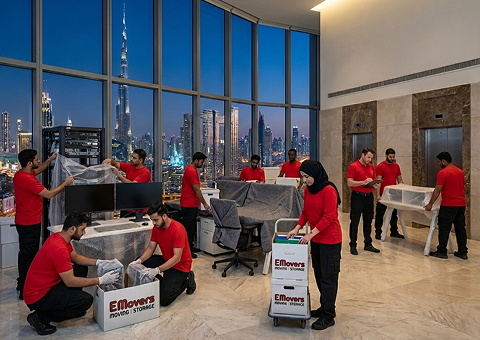
What Does a Full Office Moving Service
in Dubai Include?
A full office moving service covers pre-move survey of both sites, move plan preparation, packing and labeling, furniture disassembly, IT equipment handling, loading, transport, unloading, reassembly, IT reconnection coordination, and post-move walkthrough. Individual service components can also be booked separately based on what the business actually needs.
- ✓Dual-site survey of origin and destination
- ✓Custom move plan and schedule preparation
- ✓Furniture disassembly and reassembly
- ✓IT equipment handling with cable documentation
- ✓Document and archive chain-of-custody
- ✓Post-move walkthrough at destination
- ✓IT Infrastructure: Cable documentation before disconnection
- ✓Scheduling: Friday-to-Sunday model for zero downtime
- ✓Phased Moves: Department-by-department for live businesses
- ✓Building Access: Permits and loading bay coordination
- ✓Electronics: Climate-controlled transport in Dubai heat
Both sites are surveyed before any quote is issued. Problems at the destination are just as likely to delay a move as problems at the origin — a freight lift too small for a server rack, a loading bay with restricted truck hours, a corridor that won't fit a conference table assembled. The survey covers floor area, furniture volumes, freight lift dimensions, loading bay access at both sites, building permit requirements, and IT infrastructure scope. For a mid-sized office, a dual-site survey typically takes 90 minutes per location.
Most Dubai office moves follow the Friday-to-Sunday model. Work stops Thursday evening, the crew starts Friday evening, the physical move runs through Saturday, and staff return to a working office on Sunday morning. This is driven by building loading restrictions and Dubai's working week — not preference. For phased relocations, where one department moves while the rest of the business runs, scheduling is planned on a department-by-department basis with separate schedule blocks for each.
Modular office systems need to be dismantled, not moved assembled. Open-plan desk clusters, height-adjustable benches, glass partition screens, and demountable storage walls all need to be taken apart, transported flat, and rebuilt. Good disassembly means every component is labeled, photographed in situ before dismantling, and packed in a sequence that mirrors the rebuild order. The crew brings tools specific to commercial furniture brands — Herman Miller, Steelcase, Okamura, Vitra — and follows manufacturer specifications to preserve warranty coverage.
IT equipment handling is where most generic movers create problems. Every cable gets photographed and labeled with matching reference numbers before disconnection. A cable map is produced. Patch panel configurations are documented. Servers and rack-mounted equipment travel in anti-static packaging in climate-controlled vehicles. Dubai summer temperatures exceed 40°C — standard truck transport puts electronics at genuine risk. The client's IT team handles system integrity. The moving crew handles physical logistics. Both stay in their lane. The move plan documents where each responsibility sits.
Confidential documents need chain-of-custody handling throughout. HR files, legal records, finance archives, and client contracts travel in sealed, numbered crates with a contents manifest. The crate doesn't open between origin and destination. Access is logged. For businesses with compliance obligations under UAE data protection frameworks, this process demonstrates that confidential information was handled appropriately. Document labeling follows the department structure at the destination — not just the origin — so archives arrive already organized by department and floor section.
Different item categories in an office require different packing. Workstation equipment: monitors in foam-lined cartons, peripherals labeled and grouped by desk number, desktop towers packed upright. Printing equipment: toner cartridges removed and packed separately, paper trays removed. Conference room: AV units and display screens individually wrapped with corner protection, projectors in padded cartons. Artwork and plants need specific planning — most commercial buildings won't permit soil or living plants in freight lifts. All of these are assessed at the survey stage so the right materials and crew configuration are in place.
Dubai's standard office relocation model gives the business a full weekend to complete physical move and IT setup before staff return on Sunday morning.
An office move in Dubai is only as smooth as the plan that precedes it — dual-site survey, documented IT connections, and a weekend schedule that gets staff back to work on Sunday morning.
Whether you're relocating a startup team or a multi-floor enterprise, E MoverAE plans every element — from building permits to IT cable documentation — before the crew arrives on Friday evening.
Office Moving Specialists
in Dubai
Our commercial team understands Dubai's building access requirements, loading bay permit processes, and the Friday-to-Sunday scheduling model that keeps businesses operational. Learn more about our survey-based approach.
What Are the Building Access and Permit
Requirements for Office Moves in Dubai?
Office building permit requirements in Dubai vary by building type and ownership structure. The general principle is the same across all of them: get approved before the truck arrives, not when it's at the gate.
Standard Commercial Towers (Business Bay, Sheikh Zayed Road, TECOM)
Most standard commercial towers require a move-out permit from the building management office — typically the facilities team or building operator. Documents required generally include: a copy of the lease agreement or NOC from the landlord, the moving company's trade license and insurance certificate, and the registered truck details. TECOM-managed buildings (Dubai Internet City, Dubai Media City, Dubai Knowledge Park, Dubai Design District) have their own access system — permits go through the TECOM portal and require clearance of all lease obligations before approval. This can take several days.
DIFC (Dubai International Financial Centre)
DIFC has its own regulatory environment and its own building access requirements. Moving into or out of DIFC-managed buildings requires advance notification and permit approval from DIFC facilities management. Proof of lease termination or new tenancy documentation is required. Security at DIFC gates is strict — trucks without pre-approved documentation don't get through.
DMCC / JLT (Jumeirah Lake Towers)
JLT buildings fall under the DMCC free zone. Permit applications go through the DMCC portal — a separate process from standard building management. Lead times can be longer than standard towers. If you're vacating a JLT office, confirm the DMCC clearance requirements early and factor that into the move timeline.
JAFZA (Jebel Ali Free Zone)
JAFZA has some of the most stringent access control requirements in Dubai. Vehicles entering JAFZA need pre-approved gate passes. Staff entering the zone require valid identification registered with JAFZA security in advance. The permit process here requires the most lead time of any Dubai commercial location. Budget at least 5 to 7 working days for this.
Dubai Airport Free Zone (DAFZA)
Similar to JAFZA in terms of access control. Gate passes, vehicle registration, and advance documentation are all required before the move crew can enter. DAFZA coordinates moves through the zone management office — confirming their process and available time windows early is essential.
How Long Does an Office Move in Dubai Take?
Office move timelines depend on office size, furniture complexity, IT scope, and access conditions. These are realistic estimated ranges — not marketing figures.
Packing and disassembly typically 4 to 6 hours. Loading, transport, and unloading 2 to 3 hours. Reassembly and setup 3 to 5 hours. Total from start to operational: usually one full working day or a Friday evening plus Saturday morning.
Packing and disassembly often runs 8 to 12 hours — frequently done on the day before the physical move. Physical move day 6 to 10 hours depending on freight lift access. Reassembly and IT setup 1 day. Total: typically a 2-day operation.
Packing is usually done over 2 separate days. Physical move day 8 to 14 hours. Setup and IT reconnection 1 to 2 days. Total: 3 to 5 days. Phased relocation — one department at a time — is worth considering to keep the business running throughout.
Moving one department at a time while the rest of the business continues operating. This is often the right approach for large companies that can't afford a complete operational pause. It requires tighter coordination but keeps the business running throughout. We plan phased moves on a department-by-department basis with separate schedule blocks for each.
IT reconnection time depends entirely on the client's IT team capacity and infrastructure complexity. Simple setups reconnect same-day. Complex server and network infrastructure may need a dedicated IT day after the physical move is complete. This is coordinated in the move plan — not improvised on site.
These timelines assume building access is confirmed, freight lifts are available at scheduled times, IT team involvement is coordinated, and no significant scope additions appear on move day. Any one of these going wrong extends the timeline. This is why the dual-site survey and move plan exist — to remove as many variables as possible before the crew arrives.
What Does Office Relocation
Cost in Dubai?
Office moving costs in Dubai are driven by scope, not by square footage. These are the real factors that determine the quote. Every price follows a dual-site survey — not a per-desk estimate over the phone.
Dubai Office Move Cost Estimator
Select your office size and details for an instant Dubai market estimate (2025/2026 pricing).
Get a Precise Office Moving Quote
This is a market guide. For an exact price including permit costs and IT scope, book a free dual-site survey.
What Business Districts Does E MoverAE
Serve for Office Moves?
Office relocation services cover all major commercial zones across Dubai and the UAE. Each district has its own access requirements and building characteristics.
Why Do Companies Choose E MoverAE for Their
Dubai Office Move?
Dubai office moves have too many variables for guesswork. The value is in eliminating surprises before the move starts — not managing them on the day.
The plan comes before the crew
A written move plan is produced after the dual-site survey — not just a quote. The plan covers crew allocation by task, a room-by-room and department-by-department packing sequence, freight lift scheduling at both buildings, IT handover points between the crew and the client's IT team, and contingency notes. Everyone knows what they're doing before the move starts.
IT is planned with the IT team, not around them
We don't hand a cable to the IT team and wish them luck. The cable documentation, shutdown sequences, and startup checklists are produced collaboratively before the physical move. The crew handles the physical logistics. The IT team handles system integrity. The plan makes it clear where each responsibility sits.
After-hours and weekend moves are standard, not premium
Friday evening starts and Saturday completions aren't a special service — they're how we normally operate for commercial clients. The crews are the same quality at 9pm as they are at 9am. The supervision is the same. The accountability is the same. Most Dubai office buildings also become more accessible during these windows, which makes the physical move faster.
Free zone permit coordination is handled in advance
TECOM clearance, DMCC portal applications, DIFC building notifications, JAFZA gate pass arrangements — all of this is factored into the move plan timeline and handled as part of move preparation. You don't discover the permit problem on Friday evening when the truck is ready to load.
Make-good obligations are considered from the start
Leaving the old premises in the condition required by the lease is something most companies only think about after the furniture is gone. The damage assessment, the debris removal, the reinstatement of any installations, the final utility meter readings — we factor this into the move plan so the handover of the old space happens cleanly alongside the setup of the new one.
The move doesn't end when the last box is unloaded
After the physical move is complete, a walkthrough of the new space confirms every item is in position, every reassembled piece of furniture is stable, and the IT handover documentation is with the right team. The old premises are left in the agreed condition. Nothing is considered done until both spaces have been checked.
Frequently Asked Questions —
Office Movers in Dubai
Everything you need to know about relocating your office within Dubai — from free zone permit requirements to IT equipment handling and weekend scheduling.
Book at least 3 to 4 weeks in advance for most office relocations. This allows time for dual-site survey, written quote, permit applications, and scheduling coordination.
Free zone moves — particularly TECOM, JAFZA, and DIFC — can require longer permit lead times. Larger corporate relocations benefit from 6 to 8 weeks of planning time to allow for phased scheduling and IT coordination.
Yes, with phased scheduling and after-hours timing. The most common approach for businesses that can't afford a complete pause is to move departments in sequence over multiple evenings and weekends.
IT systems are handled department by department with a reconnection checklist at each stage. Breakout spaces or hot-desk configurations at the destination can keep staff operational while the move is ongoing.